Industrial Design Competition on Ergonomics and Aesthetics

About the Competition

Announcements

ErgoAesthetics 2027_Call for Design Projects and Ideas

2026-10-07

Call for Design Projects and Ideas

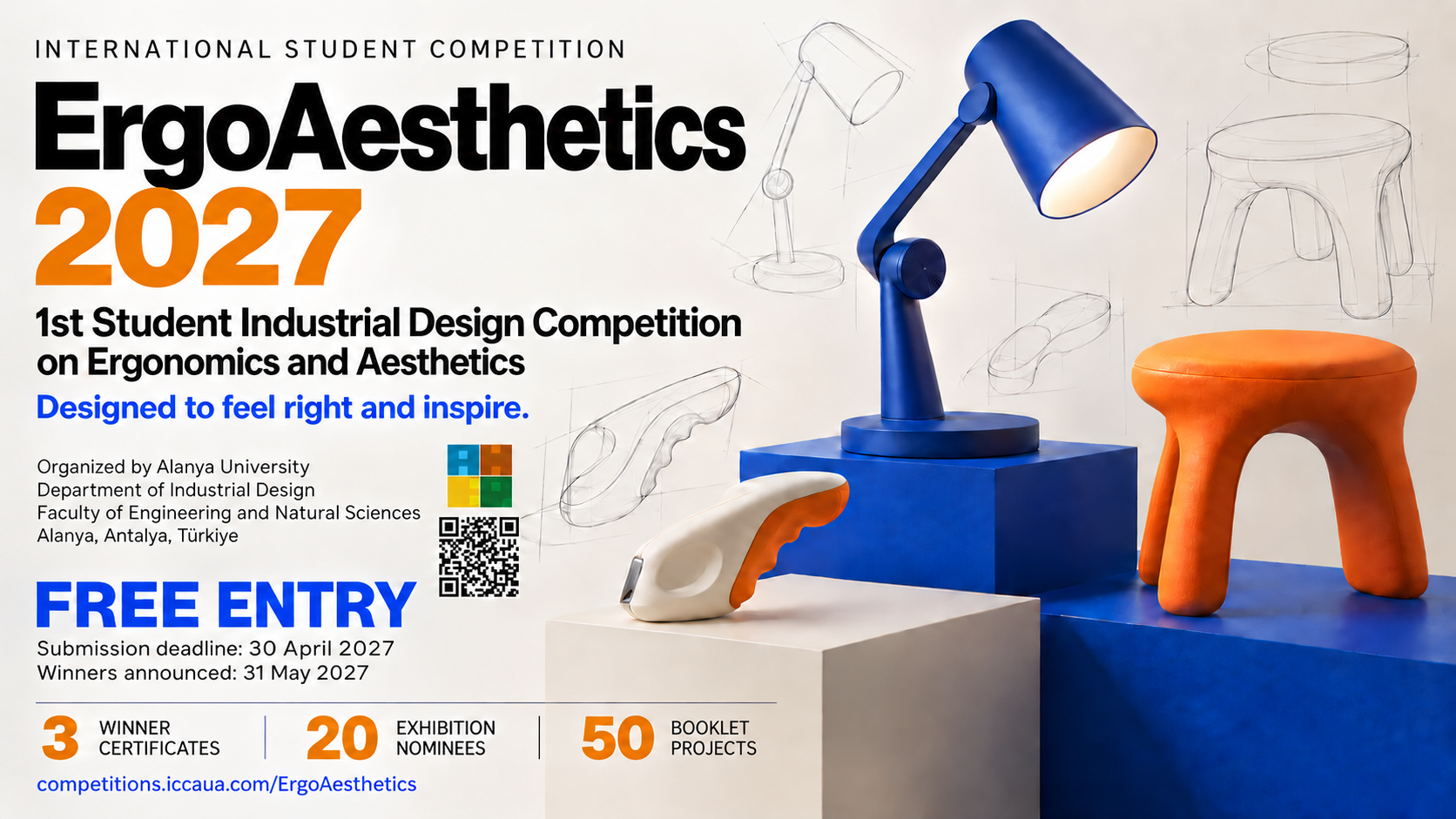
ErgoAesthetics 2027

1st Student Industrial Design Competition on Ergonomics and Aesthetics

Important dates. Final submission deadline: 30 April 2027. Announcement of winners: 31 May 2027. Check the official platform for updates and submission instructions.

Materials and templates: Download the official competition materials

Online submission: https://competitions.iccaua.com/ErgoAesthetics/user/register

Read more about ErgoAesthetics 2027_Call for Design Projects and Ideas


ErgoAesthetics 2027

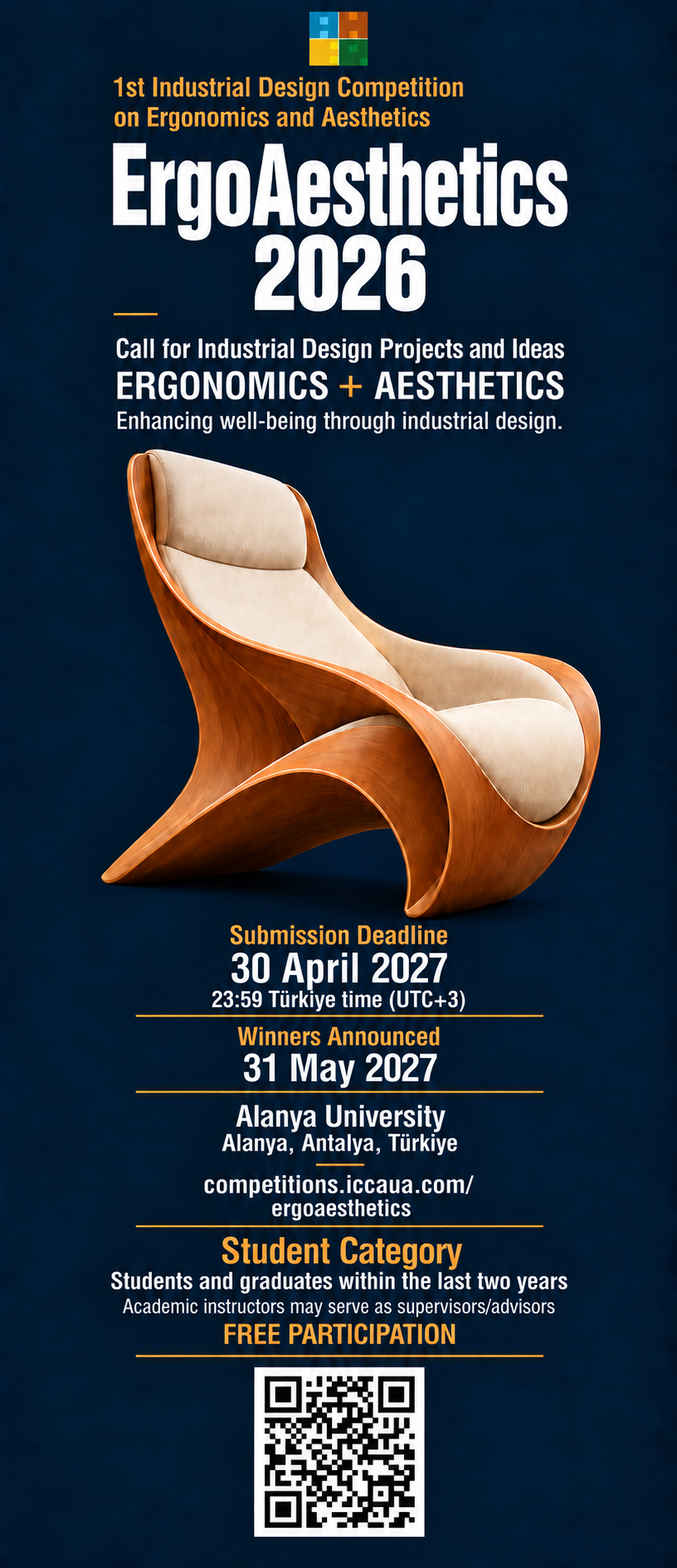
1st Industrial Design Competition on Ergonomics and Aesthetics

Call for Industrial Design Projects and Ideas

https://competitions.iccaua.com/ErgoAesthetics 

Alanya University invites students and recent graduates worldwide to explore how ergonomics and aesthetics can work together in the design of objects, products and tools. Participation is free. The competition is held online and uses a single-stage, anonymous jury evaluation.

Competition at a Glance

Competition Information

Details

Competition

1st Industrial Design Competition on Ergonomics and Aesthetics

Edition

ErgoAesthetics 2027

Competition Theme

Enhancing psychological well-being through industrial design

Host institution

Alanya University

Organizer

Department of Industrial Design, Faculty of Engineering and Natural Sciences

Host location

Alanya, Antalya, Türkiye

Competition format

International, online, single-stage, anonymous evaluation

Participation category

Students and graduates within the preceding two years

Eligible disciplines

Industrial Design, Architecture, Urban Design and Urbanism, Interior Design and Interior Architecture

Team size

Individual entry or a team of up to four eligible participants

Academic supervision

Instructors may serve as supervisors or advisors

Project scope

Objects, products and tools integrating ergonomics and aesthetics

Project status

Conceptual, unbuilt, prototyped or built student design work

Project location and scale

Any location worldwide; any appropriate object scale

Submission language

English project description; English or Turkish poster

Required files

One Word file with a description of up to 200 words; one A3 landscape PDF poster, maximum 15 MB

Participation fee

Free of charge

Final submission deadline

31 April 2027, 23:59 Türkiye time (UTC+3)

Announcement of winners

31 May 2027

Awards and selection

First, second and third place certificates; 20 exhibition nominees; 50 booklet selections


Competition Vision

Good design connects what an object does, how it feels in use and how it is perceived. ErgoAesthetics 2027 asks participants to develop a specific object or tool in which comfort, functionality, usability and visual expression support one another. A convincing proposal should show how choices of form, proportion, material, surface, colour and construction respond to the intended user and use scenario.

The competition welcomes work developed in a studio, course, thesis, workshop or independent student activity. It encourages thoughtful experimentation, clear design reasoning and responsible responses to everyday needs.

Competition Objectives

·           Demonstrate a meaningful relationship between ergonomic performance and aesthetic expression.

·           Encourage original, user-aware objects and tools with a clearly explained purpose.

·           Support inclusive design, accessibility, responsible material choices and product longevity.

·           Give emerging designers an international platform for recognition, exhibition and publication.

Student Category and Participation Conditions

Participation is open internationally to students currently enrolled in undergraduate, master’s or doctoral programmes in Industrial Design, Architecture, Urban Design or Urbanism, Interior Design or Interior Architecture. Graduates of these fields within the two years preceding the submission deadline are also eligible. For this edition, eligible graduation dates are 31 March 2025 to 31 March 2027, inclusive.

Participants may enter individually or in teams of up to four. Every competing team member must meet the eligibility conditions and have contributed to the design. All countries are welcome and there is no age restriction; any legally required permission for a minor must be obtained. Student status or graduation dates may be verified by the organizer.

Academic instructors may be acknowledged as supervisors or advisors. Supervisors are listed separately from competing authors, do not count toward the four-participant limit and do not receive a student winner designation. Supervision must remain advisory and the submitted design must be the eligible participants’ own work.

Submission Classifications and Eligible Objects

Participants may identify their disciplinary context as Industrial Design, Interior Design, Architecture or Urban Design and Urbanism. These classifications describe the entry; they are not separate award categories. All eligible entries compete within the Student Category under the same evaluation framework.

Any object, product or tool typology is welcome: furniture, seating, lighting, household products, wearable or assistive objects, work tools, packaging, play objects, urban furniture, spatial fittings, animal-care products and other clearly defined designs. Complete buildings or urban masterplans qualify only through a specific object or product developed and presented as the entry.


Users Context and Scale

Designs may respond to human users, animals or other non-human users or systems. For human use, participants should address dimensions, posture, reach, handling, accessibility, safety and interaction as relevant. For animal use, they should explain species-appropriate movement, behaviour, comfort and welfare. For other non-human applications, they should define the functional context and any human interaction rather than claim human ergonomic benefits without evidence.

Objects may be intended for any real or hypothetical site worldwide and may use any scale appropriate to their purpose. The emphasis is the designed object and the relationship between ergonomics and aesthetics. Conceptual and unbuilt designs are welcome alongside physical prototypes and built objects. Every entry must show a resolved object through drawings, a digital prototype or a physical prototype; physical manufacture or shipment is not compulsory.

Submission Requirements

Each project requires exactly two compulsory submission files. Use the official ErgoAesthetics Word and poster templates available through the competition platform.

Project Description

Submit a Microsoft Word file (.doc or .docx) containing an English project description of no more than 200 words. Explain the object, intended users, design problem, ergonomic response, aesthetic approach and how these considerations work together. Complete the template’s project and participant fields. The 200-word limit applies to the description, not to separately designated metadata or declarations.

Project Poster

Submit one A3 landscape board as a single-page PDF, measuring 420 mm wide × 297 mm high, with a maximum file size of 15 MB. Raster images must be prepared at 300 dpi at their intended printed size; text and vector graphics should remain sharp. JPG or PNG files do not replace the required PDF.

Show the concept, ergonomic analysis, principal dimensions, use scenario, aesthetic approach and object visualizations. Drawings, diagrams, sections, exploded views, photographs, renders and short explanatory text may be used. Poster text may be English or Turkish. English-language captions are encouraged for international communication.

All competing authors’ full names must appear only in the template’s designated identity area, exactly as entered in the Word form. List supervisors separately. Keep the administrative project-code area unchanged and blank. The organizer removes the identity area from the jury copy; the attributed original is retained for approved publication and exhibition.


Online Submission Process

·         Stage 1 — Download the ErgoAesthetics documents and templates from the official competition platform and prepare the two required files.


·         Stage 2 — Upload the Word file and PDF poster, confirm the required declarations and complete submission before the deadline.

Each project requires a separate entry record, whether submitted by one participant or a team. Multiple distinct projects may be submitted separately. No fee, payment page or payment receipt is required. Email submissions are not accepted. Retain the online submission confirmation.


Recognition Exhibition and Publication

The jury will award first, second and third place winner certificates. Twenty nominated projects will be selected for the competition exhibition, and fifty well-structured eligible projects will be selected for the official competition booklet published under Alanya University publications. The three winning projects form part of the twenty exhibition nominees; these twenty projects form part of the fifty booklet selections.

The announced awards are certificates, exhibition and publication opportunities. No cash prize is offered. A team receives its project distinction with all eligible competing authors acknowledged. Advisors are credited separately where applicable.

Selection depends on design quality, eligibility, originality, permissions and publication-ready materials. If fewer than the intended number of entries meet these conditions, the organizer may publish or exhibit fewer projects, with an explanation. Booklet selection alone does not confer a winner or exhibition-nominee designation.

Competition Booklet

The booklet will document selected objects through attributed posters and project descriptions. Its title will identify ErgoAesthetics 2027 and the host university. The publication date, format, editorial information and exhibition arrangements will be announced on the official platform. An ISBN or other identifier will be stated only when officially assigned.

Publication selection considers the clarity of the design, readable drawings, sound ergonomic reasoning, coherent aesthetic development, accurate authorship and suitable image quality. The organizer may adjust layout, typography, image size and captions for consistency without altering the design’s substance. Material changes require the relevant rights holder’s agreement.

Participants must verify names, affiliations, project titles and credits before final publication approval. Publication does not transfer design ownership or authorize commercial manufacture. Details of permissions, correction procedures and rights are set out in the companion Submission Criteria, Rules, Ethics & Regulations document.

Evaluation Approach

Entries are assessed anonymously. The published framework gives 30% to ergonomics and user fit, 30% to aesthetics and design coherence, 15% to their integration, 10% to originality, 10% to feasibility and environmental responsibility, and 5% to communication and supporting evidence. A conceptual proposal is judged at its declared development level; it must clearly distinguish assumptions from tested performance.

Important Dates

Milestone

Date

Final submission

30 April 2027, 23:59 Türkiye time (UTC+3)

Winners announced

31 May 2027

Exhibition and booklet publication

31 June 2027


Official Competition Platform

For regulations, current templates, registration and submission links, confirmed jurors, contact details, results and updates, visit the official competition platform. Read the full rules before submitting.

https://competitions.iccaua.com/ErgoAesthetics