FAQs
1. Competition Overview and General Information
2. Eligibility and Participation
3. Registration, Participant Accounts, Online Submission and Technical Problems
4. Registration Fees, Payments, Receipts and Refunds
5. Teams, Authorship and Multiple Entries
6. Classifications, Project Types, Sites and Scales
7. Required Files and Project Description
8. Poster Format, Layout and Graphic Content
9. Anonymity, Copyright, Ethics and Artificial Intelligence
10. Jury, Evaluation, Results, Appeals, Awards, Certificates and Publication
Official Links
Download competition materials and templates
Register and submit your project online
1. Competition Overview and General Information
What is ErgoAesthetics?
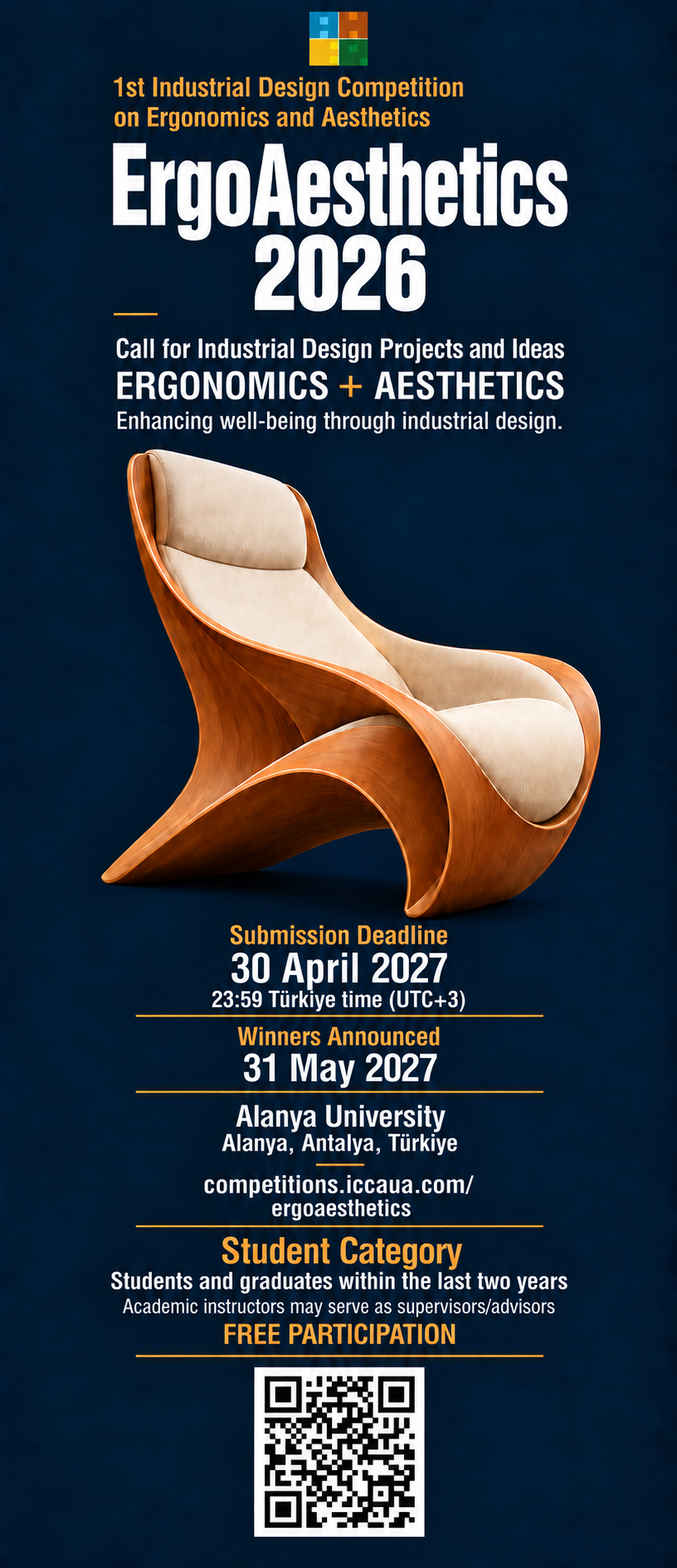
ErgoAesthetics is an international student industrial design competition exploring how ergonomics and aesthetics work together in designed objects and tools for human or non-human users.
Who organizes the competition?
The competition is organized by Alanya University, Faculty of Engineering and Natural Sciences, Department of Industrial Design, in Alanya, Antalya, Türkiye.
What is the main purpose of the competition?
The competition encourages thoughtful products that combine usability, comfort and aesthetic quality. Participants should explain how their design decisions support users and contribute to physical or psychological well-being.
What is the competition motto?
The motto is “Enhancing well-being through industrial design.” Your project should connect this ambition to a specific user need and a clearly explained design response.
Is this an international competition?
Yes. Eligible students and recent graduates may participate from any country. Projects may respond to local circumstances or propose solutions for users in any location worldwide.
Is the competition held online?
Registration and project submission take place online through the official platform. Any exhibition, ceremony or other event arrangements will be communicated separately through official competition announcements.
What does single-stage evaluation mean?
Participants submit their complete project for one evaluation stage. The format does not require a preliminary concept submission followed by a separate finalist design round.
What does anonymous evaluation mean?
The jury evaluates projects without participant identity information. Entrants complete the designated identity fields; the organizer removes the identity block and identifying metadata before preparing the jury versions.
Where can I find the official competition information?
Use the official ErgoAesthetics website for regulations, announcements, results and updates. Use the competition materials folder for the current submission form, poster templates and preparation guidance.
Where should I check deadlines and important dates?
Check the current competition announcement on the official website. Confirm the deadline, stated time zone and any official extension before submitting; do not rely on dates from earlier editions.
Does the FAQ replace the official regulations?
No. This FAQ explains the submission rules in practical terms. Read it together with the current official regulations, templates and announcements; obtain clarification if you notice conflicting instructions.
How can I ask a question that is not answered here?
Use the organizer contact details published on the official competition platform. State your question clearly and, for a technical issue, include the relevant project reference and a screenshot.
2. Eligibility and Participation
Who is eligible to participate?
Current students and people who graduated within the previous two years may enter. Eligible fields are industrial design, architecture, urban design or urbanism, and interior design.
Can undergraduate and postgraduate students enter?
Yes. The student category welcomes currently enrolled students in the eligible fields, including undergraduate and postgraduate students. Every participant must satisfy the competition’s eligibility conditions.
Can a recent graduate participate?
Yes, if graduation falls within the previous two years. Check the current call for any specified eligibility reference date, and ask the organizer if your graduation date is close to the boundary.
Must I study at Alanya University?
No. Eligible students and recent graduates from other universities and countries are welcome. Provide your own institution, department and country accurately in the submission form.
Can architecture, urban design or interior design students enter?
Yes. Your entry must focus on a specific designed object or tool and explain its ergonomics and aesthetics. A whole building or masterplan alone does not meet that object-focused brief.
Can students from different disciplines enter together?
Yes. A team may combine participants from the eligible disciplines, provided every member meets the eligibility conditions and the team contains no more than four participants.
Can current students and recent graduates form one team?
Yes. These eligible participant categories may be combined in one team. Record each member’s details correctly and ensure that every recent graduate meets the two-year condition.
Can students from different universities or countries form a team?
Yes. Team members may come from different institutions or countries. List each participant’s own university, department, country and email address rather than using one member’s information for everyone.
May an academic instructor supervise a project?
Yes. Academic instructors may act as supervisors or advisors. Credit them separately in the designated advisor field, and distinguish their guidance from the student authors’ design work.
Can an advisor be listed as a student participant?
An advisor should be credited separately. They may only enter as a participant if they independently meet the student or recent-graduate eligibility conditions and are a genuine project author.
Can I submit a project developed in a university course?
Yes, provided it is your own work, fits the brief and satisfies the submission requirements. Acknowledge genuine collaborators and academic supervision; do not claim a group project as individual work.
Do I need to provide proof of student status or graduation?
Complete the eligibility information requested by the official form and portal. Keep supporting enrollment or graduation evidence available if requested; do not add extra documents to the two-file submission unless instructed.
3. Registration, Participant Accounts, Online Submission and Technical Problems
Where do I register and submit my project?
Use the official ErgoAesthetics online submission link listed on the contents page. Complete the required information and upload the Word submission form and poster PDF through that platform.
Does downloading the templates register my project?
No. Downloading materials only gives you the documents needed to prepare an entry. You must complete the online registration and submission process for your project.
Does creating an account mean my entry has been submitted?
No. An account or registration record alone does not establish a complete submission. Finish every required field and file upload, then check the completion status shown by the platform.
Does every team member need a separate project registration?
No. One project registration covers the whole team of up to four participants. Include all members’ details; follow any account instructions displayed by the portal without creating duplicate project entries.
What should I do if I cannot sign in?
Check the email address and password you used, and use any recovery option offered by the portal. If access remains blocked, contact the organizer through the official published contact details.
What if I cannot access the competition materials folder?
Open the published materials link and check that your browser is using the intended Google account, if applicable. If permission is denied, contact the organizer rather than using an unofficial template.
What should I do if an upload fails?
Check the file format, PDF size and internet connection, then try again before the deadline. If the problem persists, report the error message, time and screenshot through the official contact channel.
How can I confirm that my submission is complete?
Check the platform’s completion status and any confirmation it provides. Keep the final uploaded files and available confirmation for your records; do not assume that selecting files completed the submission.
Can I replace files or correct details after submitting?
Use an editing option only if the portal and current rules permit it. Otherwise, ask the organizer for instructions; do not assume that submitted files can be replaced or that corrections are guaranteed.
Can I submit my project by email?
No. Email project submissions are not accepted. Email or another published contact channel may be used to report a problem, but it does not replace the required online submission.
Will technical problems automatically extend my deadline?
Do not assume so. Submit early and report problems promptly with evidence. Only an official organizer announcement or instruction can establish an extension or an alternative submission arrangement.
What should I check immediately before submitting?
Check participant names, email addresses, eligibility details, title consistency, the English description, poster dimensions, image borders and PDF readability. Confirm that both required final files are attached.
4. Registration Fees, Payments, Receipts and Refunds
Is there a registration or entry fee?
No. Participation in ErgoAesthetics is free of charge. There is no competition entry payment stage, and no registration payment is required to submit an eligible project.
Do I need to upload a payment receipt?
No. Submit only the completed Word submission form and the poster PDF. A payment receipt is not a required submission component for this competition.
Is the free-entry rule different for international participants?
No. Free participation applies to eligible entrants from all countries. Nationality or institution does not create a separate competition registration fee.
Must each team member pay a fee?
No. There is no participant fee. One project registration covers an individual entry or a team of up to four eligible participants.
Is there a fee for submitting another project?
No. Additional projects require separate registration and submission, but no competition entry payment. Prepare a complete Word form and poster PDF for each project.
Must an academic supervisor pay or register as an author?
No supervisor payment is required. Credit an academic supervisor separately as an advisor; do not register them as a student author unless they independently meet eligibility conditions and contributed as an author.
Should I follow payment instructions from another competition?
No. Instructions for IADC or other competitions do not establish ErgoAesthetics fees. Use only the current ErgoAesthetics materials and submission platform, which specify free participation.
What if a page or message asks me to make a payment?
Check that it belongs to the official ErgoAesthetics competition and contact the organizer before paying. An unexpected payment request conflicts with the free-entry conditions stated here.
What if I have already paid by mistake?
Keep the transaction record and contact the organizer and the payment recipient to clarify what occurred. The competition has no entry fee; a refund outcome or processing time cannot be assumed.
Can I request an entry-fee refund if I withdraw?
An entry-fee refund does not apply because no competition entry fee is charged. If you paid for an unrelated service, its own terms govern any cancellation or refund.
Does free entry cover my software, printing or travel costs?
Free entry means no competition registration charge. Any software, optional printing, prototype production or personal travel costs you choose to incur are separate from entering the competition.
Are booklet purchases or other optional services compulsory?
No payment receipt or optional purchase forms part of the required two-file entry. If a separate service is offered later, check its official terms; do not assume that purchasing it affects evaluation.
5. Teams, Authorship and Multiple Entries
Can I participate individually?
Yes. Individual entries are welcome. Complete only your own participant details and remove unused participant placeholders from the poster’s designated identity block.
What is the maximum team size?
A team may include up to four eligible participants. List all genuine student or recent-graduate authors; identify academic supervisors separately as advisors.
Who should be credited as a project author?
Credit people who genuinely contributed to the design and agree to the submission. Do not omit co-authors or add people solely for prestige, administrative convenience or academic seniority.
Does an advisor count toward the four-participant limit?
An advisor credited only for supervision is separate from the student author team. If that person enters as an eligible project author, they count as one of the maximum four participants.
Who should coordinate a team submission?
Choose one team member to coordinate the files and online entry. This practical role does not replace the need to provide accurate details and obtain approval from every co-author.
Should the whole team approve the entry before submission?
Yes. Agree on the final design, author list, participant details and publication information before uploading. Every listed author should know that the project is being entered.
How should participant names be written?
Use each participant’s correct full name, with identical spelling in the Word form, portal and poster. Avoid unexplained initials or nicknames that could create certificate or publication errors.
May I submit more than one project?
Yes. Each project requires its own registration, completed Word form and poster PDF. Submit distinct projects separately rather than combining several unrelated designs into one entry.
Can I enter individually and also as part of a team?
Multiple entries are permitted. Each entry must independently meet eligibility and authorship requirements, use its own complete files and clearly identify the authors responsible for that project.
Can the same project be submitted by different team members?
Coordinate one registration and submission for the jointly authored project. Separate registrations for the same team project can create duplicate records and conflicting authorship information.
Can the team membership change after submission?
Do not assume that author changes are permitted. Contact the organizer through the official channel, explain the reason and provide the agreement of affected authors before requesting a correction.
What should we do if an authorship dispute arises?
Resolve the issue with the contributors and, where appropriate, your institution. Notify the organizer if a submitted entry is affected; never alter credits or claim another person’s work without agreement.
6. Classifications, Project Types, Sites and Scales
Which product classifications are accepted?
There is no restriction to a single product category. Submit a specific object or tool and explain how its ergonomic performance and aesthetic qualities respond to the intended users.
Can I design an object for non-human users?
Yes. Objects for non-human users are welcome. Identify the intended user, relevant characteristics and use conditions, and explain comfort, interaction and aesthetic decisions without inventing biological or behavioral evidence.
Can furniture, tools or everyday household products be entered?
Yes. These are suitable examples when the project presents an original design and a clear relationship between ergonomics and aesthetics. The competition also welcomes other object types.
Can an urban or architectural object be entered?
Yes. Objects such as seating, fixtures or public-use equipment may fit the brief. Keep the specific object central and use architectural or urban context to explain its use.
Can I submit only a building, interior scheme or masterplan?
The brief requires a specific industrial design object or tool. Identify and develop that object; a general building, interior proposal or masterplan alone does not provide the required object-focused submission.
Are conceptual and unbuilt projects eligible?
Yes. Conceptual and unbuilt designs are accepted. Communicate the proposed object clearly through drawings, dimensions, use scenarios and visuals, and distinguish intended performance from tested results.
Can I submit a prototype or a built product?
Yes. Prototypes and built objects are eligible. Identify what has actually been produced, show relevant photographs where useful, and distinguish the completed elements from any proposed future development.
Is a physical prototype compulsory?
No. A physical prototype is optional. A concept can be communicated through clear renderings, technical views and analysis; do not label a digital rendering as a photograph of a real prototype.
Is there a required project site or country?
No. Projects may be located anywhere worldwide or developed for a general use context. Explain the environmental or cultural conditions relevant to your object’s design.
Is there a minimum or maximum object scale?
No fixed object scale is specified. Provide clear dimensions and units, and demonstrate that the proposed scale suits the intended users, tasks and use conditions.
Can the project be a service or an application alone?
The competition asks for a specific designed object or tool. Digital features or services may support the proposal, but explain the object itself and its physical interaction, ergonomics and aesthetic qualities.
Can I enter a previously exhibited or published project?
Check the current regulations for any prior-publication restriction. You must still satisfy eligibility, originality and permission requirements, and disclose previous presentation if the official form requests it.
7. Required Files and Project Description
Which files are compulsory?
Submit two files: the completed official Microsoft Word project submission form in .docx format and one A3 landscape project poster in PDF format. No payment receipt is required.
Must I use the official Word form?
Yes. Download the current form from the competition materials folder and complete its required fields. Keep its structure so the organizer can process project and participant information consistently.
What is the project description word limit?
The English project description must not exceed 200 words. Keep it focused and check the word count of the complete description before placing it in the official form.
What should the project description explain?
Explain the object, intended users, user need, design concept, ergonomic response and aesthetic approach. State the principal qualities and relevant context without repeating every detail shown on the poster.
In which language should I write the description?
Write the Word project description in English. The poster may be in English or Turkish; a Turkish poster does not remove the requirement for an English description.
Which project details should I provide in the form?
Complete the project title, object type, intended users and all other requested fields. Use information that matches the poster and portal, so the entry can be identified consistently.
Which participant details are required?
Provide each participant’s full name, university, department, country and email address in the designated fields. Check spellings and contact information with all team members before submission.
Should I create my own project number or identification code?
No. Leave organizer-assigned project numbers and identification fields for the organizer to complete, unless the portal or current instructions explicitly provide a code for you to use.
Can I upload a PDF instead of the Word form?
No. The description and participant information must be submitted in the required .docx form. The PDF file is the poster component, not a replacement for the Word document.
Should I submit Photoshop, PowerPoint, CAD or image files too?
No. PSD and PPTX are working template formats, and CAD or image files may help you prepare visuals. The final required uploads remain the completed .docx form and poster PDF.
Is the poster concept text the same as the Word description?
They serve different purposes. Write 40–60 words in the poster’s design-concept section and up to 200 words in the English Word description, keeping the design information consistent.
How should I name and check the final files?
Use clear filenames that distinguish the project form from the poster and follow any portal naming instructions. Reopen both files, check their contents and confirm that they are readable and not password-protected.
8. Poster Format, Layout and Graphic Content
What poster size and orientation are required?
Submit one A3 landscape board measuring 420 mm wide by 297 mm high. Portrait orientation, additional boards or a different paper size do not meet the specified poster format.
What file format and maximum size are required?
Upload the poster as one PDF file with a maximum size of 15 MB. JPG, PNG, PSD and PPTX files are not substitutes for the required final PDF.
Should I submit both pages of the sample PDF?
No. Submit only your completed poster board. The illustrated second page explains the example project and layout; it is preparation guidance and must not be included in your submitted poster.
Can I choose a different layout or redesign the header?
Choose one of the six official layouts. Retain its header, footer, university branding and central grid, and replace the sample content with your project rather than mixing or rebuilding layouts.
Where should the title, participant names and advisor credits go?
Keep the large project title at the top left and use the designated identity fields for participant names, institutions, countries and advisors. Remove unused placeholders and keep identity information out of content panels.
How many images should I put in each visual section?
Use one to four visuals in each visual section, choosing the number that maintains clarity. Include a whole-object view, technical views, development material, ergonomic explanation and aesthetics-related content across the board.
What is the maximum physical size of a photograph?
A photograph must fit inside its section border with an inset of at least 4 mm. Its maximum size is the available bordered space; preserve proportions and avoid covering text or labels.
What image resolution should I use?
Use raster images at 300 dpi at their final printed size. Keep technical drawings as vectors where possible, and check the exported PDF for sharp labels, dimensions and legible small details.
Which technical drawings and development details should I show?
Include at least two technical views with key dimensions, units and clear labels. Add relevant development sketches, material choices, assembly information, prototype details or close-up views that explain how the object works.
What should the ergonomics section demonstrate?
Identify users and use scenarios, then explain relevant posture, reach, grip, dimensions or interaction. Support decisions with appropriate references or genuine testing, and label assumptions and proposed benefits clearly.
What should the aesthetics and well-being section explain?
Explain how form, colour, texture and materials contribute to aesthetic quality and comfort. Connect these choices to the intended experience; describe psychological benefits as intentions unless supported by evidence.
Which type sizes and placeholder changes should I check?
Follow the template: title 36 pt, or 28 pt if needed; names 16 pt; headings 12.5 pt; body 10–11 pt. Replace all sample images, names, captions and instructions with your own content.
9. Anonymity, Copyright, Ethics and Artificial Intelligence
Should I remove participant names from the submitted poster?
No. Keep all participant names in the designated identity block for publication. The organizer removes that block and identifying metadata before jury review; do not delete the required identity information yourself.
Where must I avoid identifying information?
Keep participant names, signatures, participant portraits and personal logos out of the design-content panels. Put institution and advisor details only in their designated identity fields, while retaining the fixed university branding.
What counts as original work?
Submit a design you developed and are entitled to enter. Clearly acknowledge genuine contributors and external sources; copying another designer’s concept, drawings or text and presenting them as yours is unacceptable.
Can I use third-party photographs, graphics or assets?
Only use material you are entitled to reproduce in the competition, exhibition and publication context. Obtain necessary permission and provide appropriate credits; finding an image online does not establish permission.
How should I acknowledge references without revealing my identity?
Use concise source credits in relevant content areas without adding author-identifying information. Keep participant and advisor credits in the identity fields, and ask the organizer if a required reference would compromise anonymity.
Is artificial intelligence allowed?
Check the current official AI provisions before using it. Disclose any AI assistance and remain responsible for the design and submitted content; this FAQ does not establish blanket permission for entirely AI-generated entries.
How should I disclose AI assistance?
Identify the tool and explain its role, such as language editing or visualization, in the relevant disclosure field or a concise content note. Do not add participant names outside the identity block.
Can an AI image be presented as a prototype photograph?
No. Label generated or simulated visuals accurately. They must not be presented as photographs of a physical prototype, evidence of manufacturing, user-testing records or proof of measured performance.
Can I claim that the product improves psychological well-being?
Explain the intended benefit and the design reasoning. Present a measured improvement only when supported by genuine evidence, and avoid unsupported medical, psychological or safety claims.
What should I consider when showing people or user research?
Obtain appropriate permission for identifiable images and respect participant privacy. Report research and testing honestly, avoid unnecessary personal data, and distinguish observed findings from assumptions or proposed future testing.
Does entering transfer ownership of my design?
Check the official intellectual-property and publication terms before entering. Do not assume that ownership is transferred or that a particular license applies; ensure all co-authors agree to the stated terms.
What if my design contains confidential or patent-sensitive information?
Consider what can become public through exhibition or booklet publication before submitting. Obtain permission for confidential material and seek appropriate advice if disclosure could affect protection of an invention.
10. Jury, Evaluation, Results, Appeals, Awards, Certificates and Publication
Who evaluates the projects, and are jury identities published?
The competition jury evaluates projects anonymously. Consult the official platform for the announced jury members and their roles rather than assuming who will assess your entry.
What will the jury consider, and are there fixed scoring weights?
Show a convincing relationship between ergonomics and aesthetics through clear design communication. Consult the official evaluation criteria; do not assume numerical weights or scoring thresholds.
Where and when will results be announced?
Check the current competition schedule and official website. Published announcements confirm awards, nominations and publication selections; informal messages and previous editions are not reliable confirmation.
Will every entrant receive individual jury feedback?
Individual feedback or a detailed score report is not guaranteed. Check the official arrangements and use any feedback made available through the competition’s published channels.
Can I appeal a result or report a procedural concern?
Follow any published appeal or complaint procedure. Contact the organizer with a specific concern and evidence; do not assume a right to re-evaluation, an appeal deadline or a changed result.
What awards are offered?
First, second and third places receive winner certificates. Twenty nominated projects are selected for exhibition, and fifty selected projects are included in the competition booklet. No cash prize is specified here.
How will participant names appear on certificates?
Accurate names in the form and poster support correct credits. Check official arrangements for certificate format, delivery and team-member recognition; report spelling errors promptly through the published contact channel.
What does selection among the twenty exhibition projects mean?
Twenty nominated projects are selected for the competition exhibition and booklet. Consult the official announcement for exhibition format, location and display arrangements; nomination does not automatically mean a first-, second- or third-place award.
How are the fifty booklet projects different from exhibition nominations?
Fifty well-structured projects are selected for booklet publication, while twenty projects receive exhibition nominations. These selections may overlap; they should not be interpreted as seventy separate selected projects.
Who publishes the booklet, and is publication guaranteed?
The booklet is published under Alanya University publications. Entry does not guarantee selection. Consult official publication announcements for timing, format and any identifiers; do not assume an ISBN, DOI or printed copy.
Must selected participants attend an event or pay travel costs?
Follow any official instructions issued to selected participants. Online entry does not establish an attendance requirement or a promise of funded travel; confirm practical arrangements before making bookings or incurring costs.
Can project details be corrected after results or before publication?
Report an error promptly through the official organizer contact channel, identifying the project and requested correction. Approval depends on the publication stage and official procedure; do not assume revised files will automatically replace the selected entry.